Why Fine-Tuning an LLM Shouldn’t Cost $300: Solving GPU Scarcity, Cloud Markups, and OOM Crashes
How autonomous multi-cloud failover, cryptographic financial permits, and preflight VRAM guards eliminate the hidden taxes of AI training.
The 2:00 AM Cloud GPU Nightmare
If you’ve ever tried to fine-tune an open-source Large Language Model (Llama 3.2, Qwen 2.5, DeepSeek R1), you’re intimately familiar with the following ritual:
You budget $20 on a cloud provider to run a parameter-efficient fine-tuning (PEFT/LoRA) job.
You spend 45 minutes configuring drivers, CUDA versions, and environment dependencies.
Ten minutes into your training loop, PyTorch crashes with the dreaded:
CUDA out of memory. Tried to allocate 2.14 GiB (GPU 0; 23.69 GiB total capacity)...You fix your batch size, only to discover that the cloud provider just ran out of spot capacity and preempted your node.
You spend the next hour hopping between RunPod, VastAI, Hyperstack, and Lambda Labs, desperately hunting for an idle A10G or A100.
By the time you finally get a model trained, you’ve spent more time fighting cloud infrastructure and burning money on failed runs than actually improving your model’s weights.
We built Vivacious Cloud to solve this broken workflow from first principles.
The Reality of Modern GPU Clouds: A Live Look Under the Hood
Most centralized cloud providers charge retail markups of 400% to 700% on GPU compute. Meanwhile, decentralized and boutique cloud providers offer GPUs at massive discounts — often below $0.70/hour — but suffer from unpredictable availability and API turbulence.
Here is an unvarnished look at what happens behind the scenes when a training job attempts to acquire compute across multiple clouds:
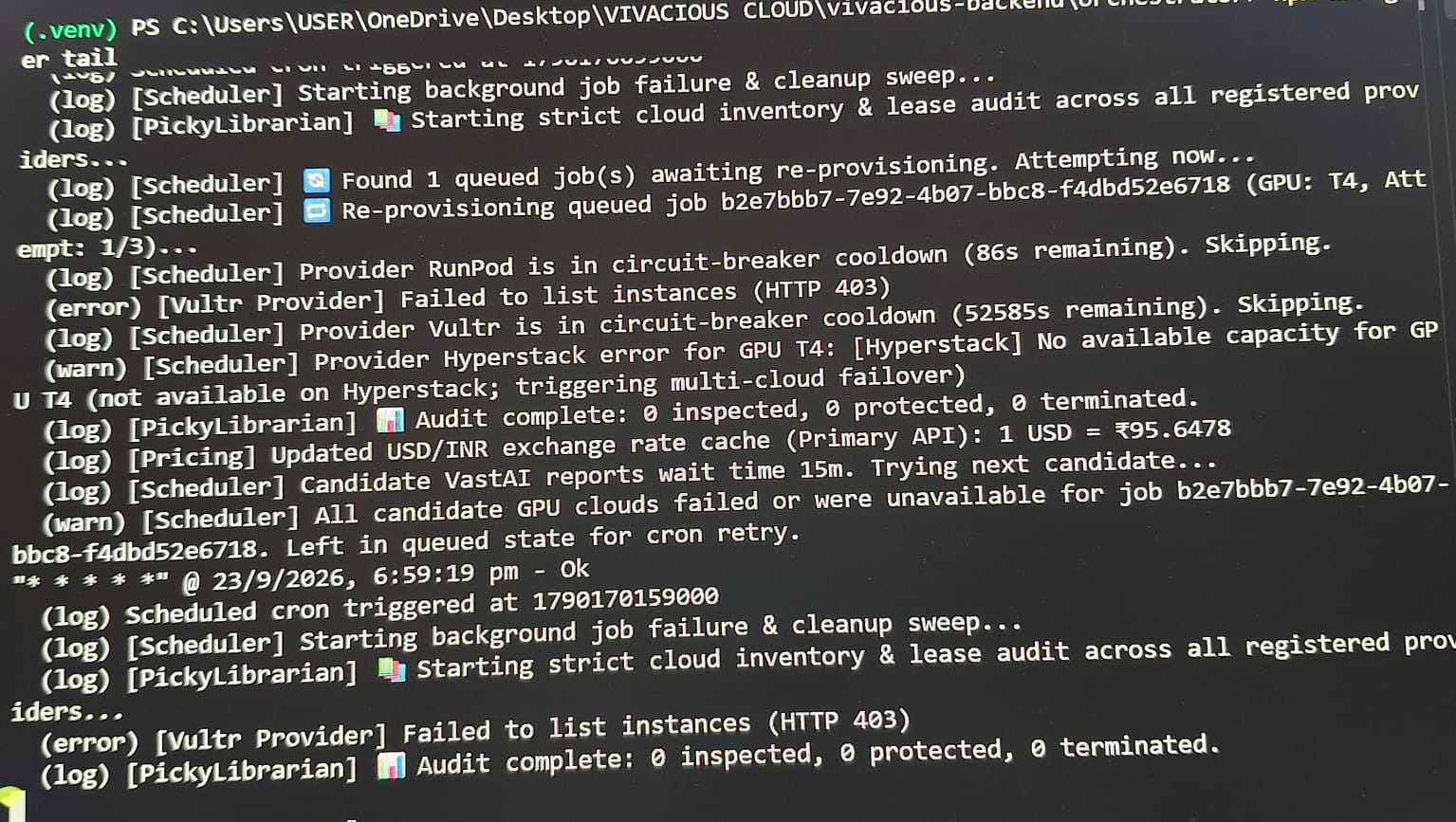
Notice what is happening in those logs:
Automatic Multi-Cloud Failover: When Hyperstack runs out of T4 capacity, the job doesn’t crash. The orchestrator immediately fails over to the next candidate cloud in the spot pool.
Adaptive Circuit Breakers: When Vultr returns an HTTP 403 or network timeout, the system places that provider into an intelligent cooldown window so your pipeline doesn’t hang.
PickyLibrarian Ghost Lease Protection: One of the biggest fears in cloud computing is the “ghost instance” — a machine that crashes during startup but continues billing your credit card. Our background auditor (
PickyLibrarian) continuously audits live instances and terminates orphaned leases immediately.
Locking In Financial Transparency Before Spending a Single Penny
Why should developers have to guess how much a training run will cost?
In Vivacious Cloud, all operations begin locally:
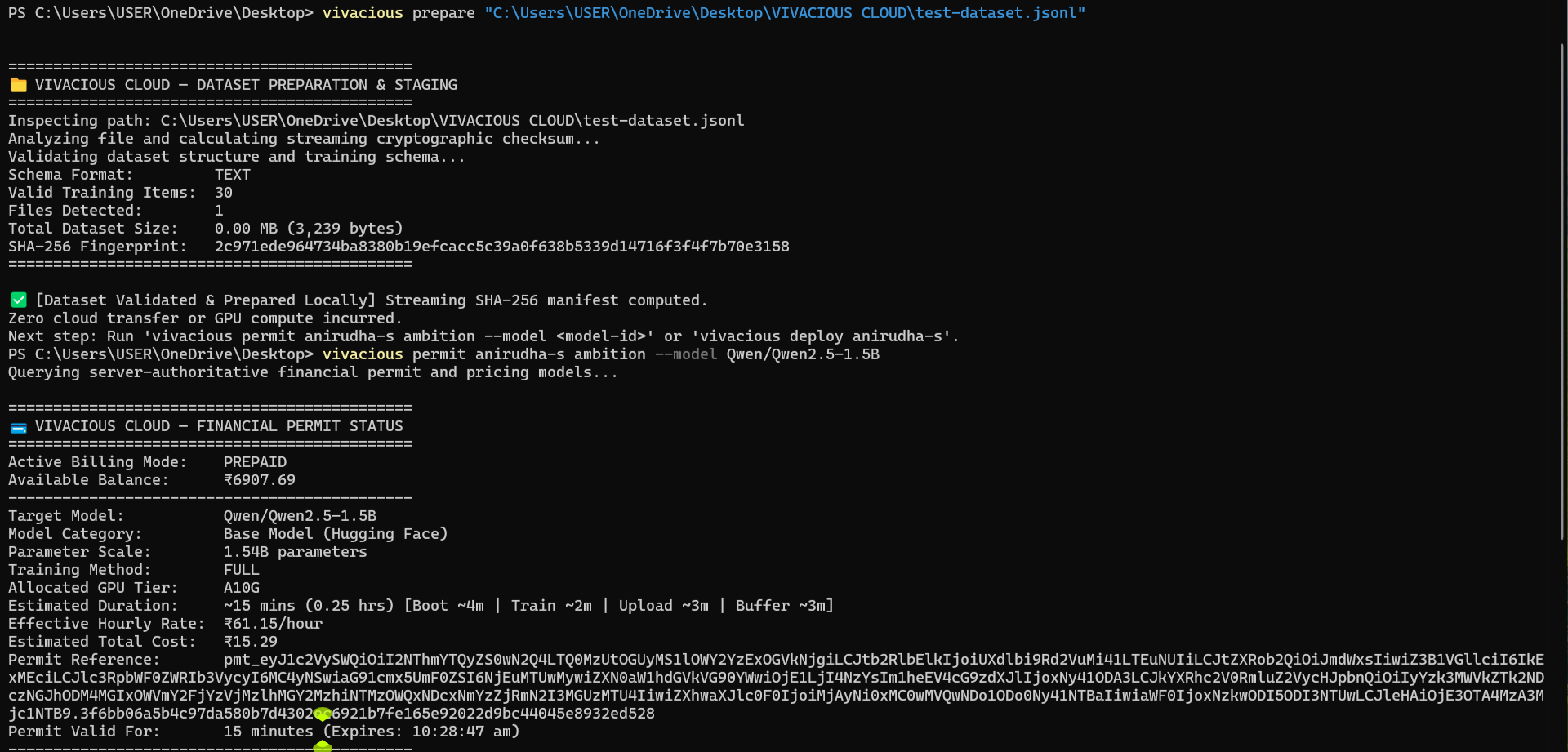
Zero-Cost Local Validation: The CLI validates your training dataset format, parses schema consistency, and computes a cryptographic SHA-256 manifest locally on your machine — incurring zero cloud transfer or GPU compute charges.
Preflight VRAM Protection: Before launching, the engine calculates the exact memory footprint:
If your sequence length or batch size will trigger an Out-Of-Memory failure, the system stops you before you pay for boot time.Server-Authoritative Financial Permits: You receive a cryptographically signed permit with an exact breakdown:
Target Model: Qwen 2.5 (1.54B parameters)
Allocated GPU: NVIDIA A10G
Estimated Duration: ~15 mins (Boot: 4m, Train: 2m, Upload: 3m, Buffer: 3m)
Locked Total Cost: ₹15.29 (~$0.18 USD)
No surprise bills at the end of the month. No opaque pricing tables.
Test It in Your Browser (No Login, No Credit Card)
You shouldn’t have to install software or hand over a credit card just to understand how your model’s memory footprint and cloud arbitrage work.
We deployed an interactive terminal simulator directly on Hugging Face Spaces:
👉 Try the Vivacious Terminal Simulator on Hugging Face
Inside the simulator, you can:
Test live VRAM estimation across models like Llama 3.2 3B, Qwen 2.5 7B, and DeepSeek R1 Distill.
Inspect our radial VRAM gauge to see how LoRA rank decomposition alters memory consumption.
Compare standard on-demand cloud pricing against multi-cloud spot arbitrage across 12 independent providers.
Explore the Open-Source Ecosystem
We believe modern developer tooling should be transparent, reproducible, and community-driven:
⭐️ Open-Source CLI on GitHub: Viavcious-cloud/vivacious-cli
Inspect our preflight dataset validators and orchestration client.📦 Curated PEFT Starter Dataset: vivacious-cloud/sample-llm-finetuning-dataset
A clean, public-domain (CC0) instruction-tuning dataset formatted for immediate parameter-efficient training.🌐 Production Platform: vivaciouscloud.com
Built for indie developers, students, and research teams who want enterprise-grade fine-tuning infrastructure without enterprise markups.
What’s Your Biggest Cloud Bottleneck?
Are you currently paying on-demand retail rates on AWS/GCP, or are you wrestling with spot preemptions and out-of-stock notices across multiple dashboards?
Drop your thoughts and questions in the responses below — I’d love to hear how you manage your GPU pipelines!